
Treatment goals are the backbone of the clinical record. They explain why the client is in therapy, what you are working toward together, and how anyone reading the chart can tell whether it is working. Insurance reviewers look for them. Auditors look for them. A colleague covering your caseload would look for them first.
Most therapists write goals once, at intake, and then rarely look at them again. The plan sits in one place and the progress notes sit in another, and the connection between the two lives only in the clinician's head. This post covers how to write goals that hold up, with examples, and how to make sure your notes actually point back to them.
Goals, objectives, and interventions
These three terms get blurred together, but they do different jobs in a treatment plan.
- Goal: the broad outcome the client wants. "Reduce depressive symptoms and return to previous level of functioning."
- Objective: a specific, measurable step toward the goal. "Client will engage in at least three pleasurable activities per week, as reported in session."
- Intervention: what you will do to help. "Therapist will use behavioral activation and weekly activity scheduling."
Plenty of practices write measurable goals and skip the separate objective layer. That is fine. What matters is that somewhere in the plan there is something specific enough that you could look at a session and say whether the client moved toward it.
What makes a goal measurable
The SMART framework (specific, measurable, achievable, relevant, time-bound) is the most common standard, and it works well for therapy as long as you don't let it turn your goals into something the client wouldn't recognize. A few practical tests:
- Could a stranger tell if it happened? "Feel better about work" fails. "Attend work at least four days a week without calling out due to anxiety" passes.
- Does it have a number or a behavior? Frequency (twice a week), a score (PHQ-9 below 10), or an observable action (completes a thought record) all count.
- Does it have a timeframe? "Within 12 weeks" or a review date gives you a natural point to reassess.
- Would the client agree with it? Goals written in the client's own terms tend to get worked on. Goals written for the payer tend to get ignored.
Weak goals vs. strong goals
Weak
- Client will improve coping skills.
- Client will process trauma.
- Client will have better communication with partner.
Strong
- Client will use at least one grounding skill when panic symptoms begin, as reported in session, on most days over the next 8 weeks.
- Client will complete a written trauma narrative and report a reduction in PCL-5 score of at least 10 points within 16 weeks.
- Client and partner will use a structured time-out at least once a week during conflicts, as reported by both, within 6 weeks.
The weak versions aren't wrong clinically. They just give you nothing to document against. When a reviewer reads a progress note, they want to see movement toward something. "Improve coping skills" makes every session look the same.
Treatment goal examples by presenting problem
Depression
- Client will engage in social contact with friends or family at least twice a week.
- Client will schedule and complete at least three value-based activities per week.
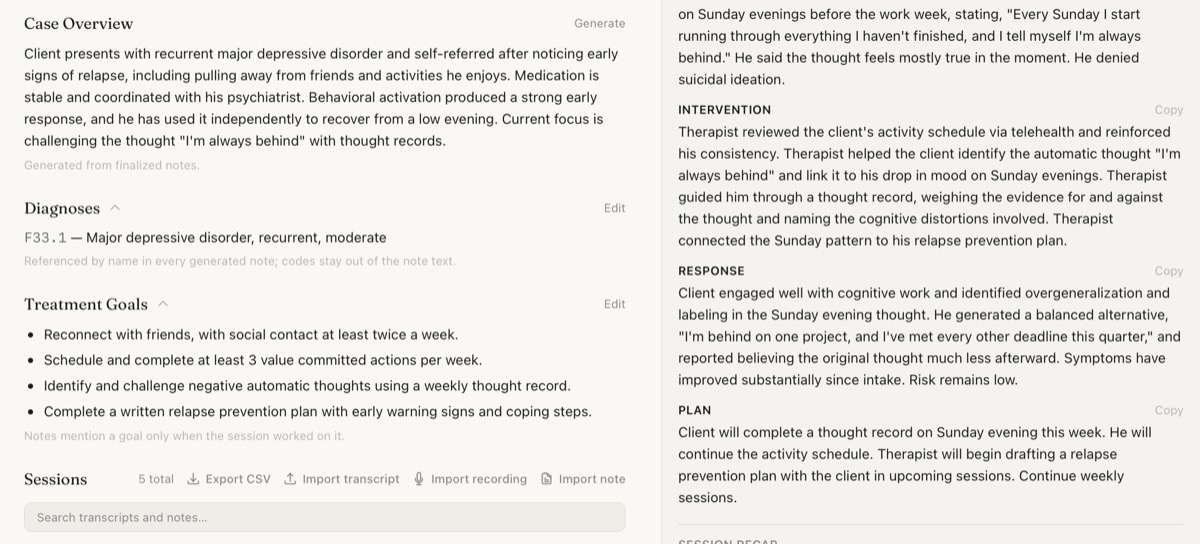
- Client will identify and challenge negative automatic thoughts using a weekly thought record.
- Client will complete a written relapse prevention plan with early warning signs and coping steps.
Anxiety
- Client will reduce GAD-7 score from 15 to below 10 within 12 weeks.
- Client will complete at least two steps of an exposure hierarchy per week.
- Client will limit reassurance-seeking to once per day, as tracked in a log.
Grief
- Client will return to at least two activities they stopped after the loss.
- Client will identify and use two people they can talk to about the loss outside of session.
Substance use
- Client will reduce drinking days from five per week to two or fewer, as tracked in a weekly log.
- Client will identify three high-risk situations and a written plan for each.
Connecting goals to your progress notes
This is the part most documentation skips. A strong treatment plan doesn't help much if the progress notes never mention it. Each note should make it clear which goal the session worked on and whether the client moved toward it.
The format you use shapes where that shows up. In a SOAP note it usually lands in the Assessment. In a DAP note it lands in the Assessment too. In BIRP, the Intervention section names what you did toward the goal and the Response section shows how the client responded, which makes BIRP an especially natural fit for goal-based documentation. GIRP goes one step further and opens every note with the goal itself; there's a full GIRP example here. If you're choosing a format, the post on SOAP vs DAP vs BIRP notes covers the differences.
A short example. Goal: "Identify and challenge negative automatic thoughts using a weekly thought record." A Response section that ties back to it might read: "Client engaged well with cognitive work and identified overgeneralization in the thought 'I'm always behind.' He generated a balanced alternative and reported believing the original thought much less afterward." No goal number, no jargon, but anyone reading the chart can see the plan at work.
Reviewing and updating goals
Goals are not permanent. Many payers and agencies expect treatment plans to be reviewed on a set schedule, often every 90 days, and even without that requirement a regular review is good practice. At each review, note which goals were met, which still apply, and which need to change. When a client meets a goal, say so in the chart. It is one of the clearest pieces of evidence that treatment is working.
If a goal hasn't moved in months, that is worth documenting too, along with what you are changing in response. Stalled progress with a clear plan reads very differently from stalled progress with no comment at all.
How Confidant handles treatment goals
In Confidant, each client has a Treatment Goals section on their page. You enter the goals once, one per line, in your own words. When Confidant writes a progress note, it reads the session alongside those goals and mentions a goal only when the session actually worked on it. The note shows the plan in action without listing every goal every time.
Like everything else in Confidant, the goals and the notes stay on your computer. The local AI that writes your notes runs on your own machine, so your treatment plans never pass through a cloud server or data center. It writes SOAP, DAP, BIRP, GIRP, PIRP, and SIRP; see every format.
The short version
- Write goals a stranger could check: a behavior, a number, or a score, with a timeframe.
- Use the client's language where you can.
- In each note, name the goal the session worked on and how the client responded.
- Review goals on a schedule and document when they are met or changed.
For full examples of what strong notes look like, see the post on therapy progress note examples.